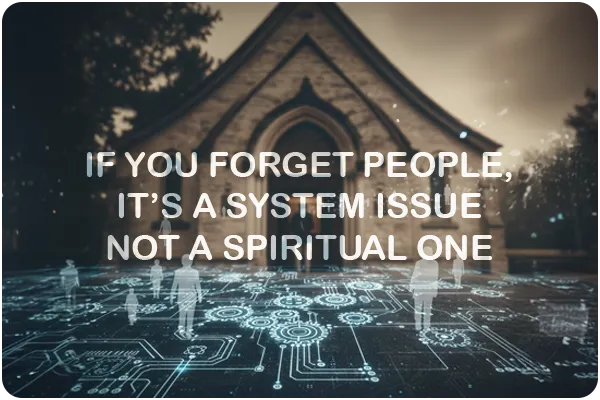
If You Forget Church Visitors, It's Not a Spiritual Failure—It's a Systems Problem
Listen to the full podcast below! ⬇️
How to Stop Losing Visitors Through Better Church Follow-Up Systems
Every Sunday, churches across America welcome first-time visitors. These guests arrive hopeful, curious, and often vulnerable—looking for connection, community, and belonging.
But by Wednesday, many of these same visitors have already decided they won't return.
Not because the sermon was bad. Not because they felt unwelcome. But because no one followed up.
If you're a pastor who's ever felt guilty about forgetting to reach out to a visitor, this article will free you from that burden—and show you exactly how to fix the problem.
The Hidden Burden Pastors Carry
I've worked with hundreds of churches, and I keep hearing the same confession from pastors:
"I saw the connection cards on Monday. I genuinely wanted to call them. But the week got away from me, and by the time I remembered, it was too late."
The guilt that follows is crushing. Pastors wonder: Am I a bad shepherd? Do I not care enough? Is this a spiritual failure?
Here's the truth that will set you free:
If you forget people, it's not a spiritual issue. It's a systems issue.
Why Your Brain Can't Be Your Church Management System
Your brain is an incredible gift from God. But it wasn't designed to simultaneously track:
New visitor names and contact information
Follow-up timing for each person
Prayer requests from multiple families
Volunteer coordination
Sermon preparation
Counseling appointments
Hospital visits
Staff meetings
Your own family's needs
Expecting yourself to mentally juggle all of this without dropping a single ball isn't spiritual discipline—it's an impossible standard.
The pastors who succeed at visitor follow-up aren't more spiritual than you. They have better systems.
What Is a Church System? (And Why God Designed Them)
When some pastors hear "systems," they immediately think: That sounds corporate. That sounds cold. Church should be more organic than that.
I get it. But let me reframe this completely.
A system is simply a repeatable process that produces a consistent result.
And honestly? God is the ultimate system designer.
When my wife was pregnant with our daughter, I sat in the OB appointments watching ultrasounds in absolute awe. The baby's heart forms first—because the heart brings life. Then the brain develops. Then organs, limbs, everything in precise order.
God didn't create life randomly. He designed a system—an intentional, step-by-step process that produces a consistent, miraculous result.
Now imagine if God had created everything out of order. People first, then light and sky afterward. That would be chaos.
The order matters. The design matters. The system matters.
That's exactly what church follow-up systems do—they create order so that love can flourish consistently, not just on the weeks when you have extra energy.
The Silent Message of No Follow-Up
Here's what most church leaders don't realize:
When you don't follow up with a visitor, you're sending a message—even though you never intended to.
The visitor doesn't know you're overwhelmed. They don't know someone was in the hospital. They don't know you had a crisis.
All they know is: "I showed up vulnerable, hoping to connect... and no one reached out."
Silence gets interpreted.
And visitors often interpret that silence as:
"Maybe I'm not important enough"
"Maybe this church isn't really welcoming"
"Maybe I misread the vibe on Sunday"
The tragedy? That person might have been one conversation away from finding community, healing, or hope. But the silence became their answer.
Struggling with guest follow-up? Our Free A.C.R. Method training walks you through building a complete system. (CLICK HERE TO GET YOUR FREE ACCESS)
Real Results: How One Church Doubled Visitor Retention
Let me share a real transformation story.
I worked with a church in the Midwest—about 120 people. The pastor was exhausted and discouraged because they were losing half their visitors after the first Sunday.
He'd look at connection cards every Monday thinking, "I need to call these people." But by the time he got around to it, a week or two had passed. When he finally reached out, most didn't answer. Those who did were polite but distant.
We helped him build a simple three-step system:
Step 1: Every visitor gets an automated welcome text within 2 hours of leaving their info
Message: "Hey [Name], thanks for visiting [Church Name] today! We're so glad you were here."
Step 2: Within 24 hours, a trained volunteer calls—not to sell anything, just to say hi and answer questions
Step 3: Within the week, they receive a personalized invite to a newcomer lunch or coffee with the pastor
The results?
Six months later, their first-time visitor retention went from 30% to nearly 60%. People were coming back. Joining small groups. Getting baptized.
And the pastor said something that stuck with me: "I finally have energy to shepherd again because I'm not drowning in follow-up."
That's what church systems do—they don't remove the personal touch. They make the personal touch possible.
5 Signs Your Church Follow-Up System Is Broken
How can you tell if your visitor follow-up needs help? Here are five warning signs:
1. Delayed Response Time
If visitors don't hear from you for 3+ days, your system is broken. Research shows that speed matters significantly in visitor retention.
2. Inconsistent Follow-Up
Some people get calls, some don't. Some get emails, others fall through the cracks. Inconsistency signals a process problem, not a people problem.
3. Overwhelmed Volunteers or Staff
If your team constantly feels buried or plays catch-up, there's no supportive process in place.
4. Repeat Mistakes
When the same issues keep happening—missed prayer requests, forgotten names, dropped connections—that's not a personnel issue. It's a systems issue.
5. You're Relying on Memory
If your follow-up depends on someone remembering to do it, you don't have a system. You have hope. And hope is not a strategy.
The 80/20 Rule of Church Automation
Here's something that transforms how pastors think about their time:
Once you build a proper system, it handles 80-90% of your follow-up automatically.
That means you only focus on the 10-20% that truly needs your personal touch.
The 80% (Automated):
Initial welcome messages
Reminder texts about service times
Thank-you emails after first visits
Invitations to upcoming events
Check-ins when someone misses a Sunday
The 20% (Personal):
Responding to someone in crisis
One-on-one prayer
Addressing specific questions or concerns
Building deeper relationships over coffee
The system doesn't replace you. It clears the clutter so you can focus on what only you can do.
You're not a robot. You're a shepherd. But even shepherds need tools—a staff, a fence, a system to keep the flock safe.
Start With One Simple Step Today
If you're feeling overwhelmed and don't know where to start, I have one assignment for you:
Send one thank-you text within 24 hours of someone visiting your church.
That's it. Not an email. Not a call. A simple text:
"Hey [Name], this is Pastor [Your Name]. Just wanted to say thanks for visiting us on Sunday. Hope to see you again soon!"
Here's what will happen: You'll start seeing responses. People will text back. They'll feel seen. And that small win will build momentum.
Once you nail that one step, you add the next step. Then the next. Before you know it, you've built a complete visitor follow-up system.
Are Church Systems Biblical?
Some pastors still wonder: Isn't this approach too corporate? Shouldn't ministry be more organic?
Let me flip the question:
Is it spiritual to let people fall through the cracks because you're disorganized?
Is it loving to forget someone because you were too busy?
Is it good stewardship to waste time on chaos instead of creating order?
Jesus was intentional. He had a plan. He sent out the seventy-two disciples in pairs with clear instructions. The early church had systems for caring for widows and distributing resources fairly.
Using systems isn't unspiritual. It's biblical.
It's stewarding what God has given you—time, people, relationships—faithfully and wisely.
The Real Cost of "We'll Remember to Follow Up"
Many churches operate on good intentions: "Don't worry, we'll remember to follow up with visitors."
But intention without execution is just wishful thinking.
Every Sunday that passes without a reliable follow-up system costs you:
Visitors who never return
Members who drift away unnoticed
Opportunities for life change that slip through the cracks
Pastor burnout from carrying an unsustainable load
The question isn't whether you care about people. The question is whether you have the infrastructure to care consistently.
Next Steps: Building Your Church Follow-Up System
If you're ready to stop losing visitors and build a church growth system that actually lasts, here's how to get started:
Audit your current process - Track what happens (or doesn't happen) after someone visits
Implement the 24-hour text rule - Start with one simple, consistent touchpoint
Build a three-step system - Welcome message, volunteer call, pastoral invitation
Train a small team - You can't do this alone; equip volunteers to help
Use automation wisely - Let technology handle the 80% so you can focus on the 20%
Remember: Small steps over time create massive results.
You don't need to overhaul everything overnight. You just need to start with one reliable process and build from there.
Free Training: The A.C.R. Method for Church Growth
Want to dive deeper into building these exact systems in your church?
I've created a free training on the A.C.R. Method—Attraction, Connection, Retention—that walks you step-by-step through creating automated follow-up systems that work.
You'll learn:
How to attract new visitors consistently through digital outreach
How to connect with guests before they ever step foot in your church
How to retain members with automated check-ins and care systems
The exact text and email sequences we use with churches
Get free access at mychurchautomation.com/free-training
Final Thought: Systems Are an Act of Love
Here's what I want you to remember:
Forgetting people isn't a spiritual failure. It's a systems opportunity.
When you build reliable processes for visitor follow-up, you're not being less spiritual—you're being a better steward.
You're creating space for love to flourish consistently. You're protecting your calling instead of burning out. You're making sure no one falls through the cracks simply because life got busy.
That's not corporate. That's not cold.
That's faithful stewardship of the people God has entrusted to you.
Related Resources:- The Hidden Cost of “We’ll Remember to Follow Up”- Why Most Churches Lose People Between Sunday and Wednesday- Download: 7 Automation Every Growing Church Needs
